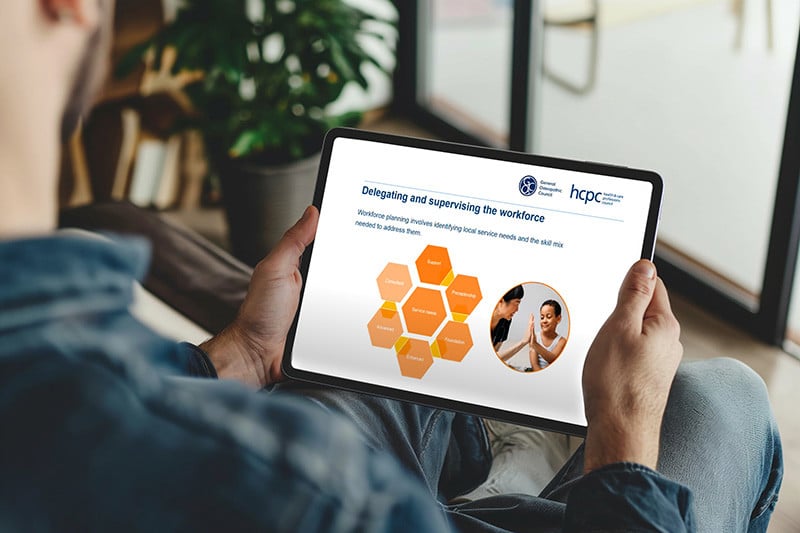
Over the course of your career, you may be expected to delegate activities, or parts of activities, to registered colleagues, support workers and others within or outside of your organisation
Meeting your standards means that whether you are delegating within or beyond an organisation, it’s important that you do this safely and effectively. Delegation is a relational activity used to meet service user needs, provide support for the people you are delegating to and make the best use of knowledge, skills and experience within and across teams.
These pages outline the key responsibilities and benefits of safe and effective delegation and offer practical questions for consideration when meeting your HCPC standards.
What is delegation?
Delegation is where an activity, or part of an activity, is handed over to another person who is capable of undertaking that activity without direct supervision.
The HCPC standards of conduct, performance and ethics shape the key requirements for safe and effective delegation.
You must only delegate work to someone who has the knowledge, skills and experience needed to carry it out safely and effectively (4.1)
You must continue to provide appropriate supervision and support to those you delegate work to (4.2)
What delegation is not
Delegation is different from referring on. When a registrant refers onto another colleague, they are doing so because they assess the needs of the service user are beyond their scope of practice, meaning the service user will be better served from working with another professional. Once the referral has been accepted, the original registrant is not required to provide ongoing support to their colleague who now leads the episode of care.
Delegation is different from supervision. Supervision is a process of professional learning and development through the provision of regular support. Delegation is a process to meet service needs whereby an activity, or part of an activity, is delegated from the registrant to another person while the registrant retains accountability for the overall outcome.
Approaching delegation
Delegation must always be in the best interest of your service user and decisions to delegate will reflect individual service user needs and your own professional judgement. You will also use your professional judgement to decide the level of supervision or support required by the person you are delegating to, so they can undertake the activity safely and effectively.
When deciding whether to delegate a task, you may wish to consider the following (adapted from the British Dietetic Association 2025):
- Is delegation in the best interest of the service user?
- Is the activity, or the part being delegated, within the job role for the member of staff?
- Has relevant and appropriate training and education been provided?
- Has / does a competency for the activity need to be demonstrated, assessed and signed off?
- Are there appropriate and relevant protocols and policies in place for the activity being delegated?
- Are the wider team aware of the delegation plans e.g. the line manager for the person being delegated to?
- What are the arrangements for regular support and supervision?
- Is it still in the best interests of the service user?
Responsibilities and liabilities
In addition to delegating to others, registrants may also be delegated an activity, or part of an activity, from another professional. When accepting a delegated activity, registrants are required to use their professional judgement to determine if it is within their scope of practice (as outlined in standard 3: work within the limits of your knowledge and skills) and need to consider the following:
- Do I have the skills, knowledge and experience to carry out the activity safely and effectively?
- How can I demonstrate that the activities within my scope of practice meet service user needs (for example via standards, guidance, policies, research, audit data)?
- If the activity is not within my current individual scope of practice, can I complete training or receive other support (such as supervision) that will give me the skills, knowledge and experience needed to carry out the activity safely and effectively?
- Is the activity restricted by law (such as prescribing) and, if so, can I legally do it?
- Does my professional indemnity arrangement (including organisational policies and insurance) cover the activity?
Approaching delegation is therefore a shared responsibility between the person delegating, the person being delegated to and the organisation(s) in which they work.
Benefits of delegation
Delegation enables service user needs to be met by making the most of the knowledge, skills and experience across teams (sometimes referred to as scope optimisation). The workforce is also provided with opportunities to develop capability and skills, as staff become more skilled and advanced in their duties. This helps ensure more advanced skills are nurtured and transferred. Therefore, by delegating pragmatically and safely, pressure across teams can be relieved.