
Mae’r lefelau ymarfer yn fframwaith datblygu’r gweithlu sy’n disgrifio camau ar gyfer y gweithlu eang ym maes iechyd a gofal.
Nid yw’r lefelau ymarfer yn ofyniad rheoleiddiol, ac mae safonau’r HCPC yn berthnasol i unigolion cofrestredig ar bob lefel ymarfer. Mae’r dudalen hon yn rhoi trosolwg o’r lefelau ymarfer uwch gan egluro sut maent yn cefnogi ymarfer proffesiynol diogel ac effeithiol sy’n diwallu anghenion defnyddwyr gwasanaethau.
Diffinio lefelau ymarfer uwch
Dyma dair lefel ymarfer uwch yn y Deyrnas Unedig:
- Estynedig (yng Nghymru a Lloegr) neu Arbenigol (yng Ngogledd Iwerddon a’r Alban)
- Uwch
- Ymgynghorol
Mae’r rhain yn datblygu ar seiliau lefelau ymarfer blaenorol a elwir weithiau yn mynediad, sylfaen neu newydd gymhwyso. Ceir nifer o rolau a theitlau swyddi gwahanol ar draws sectorau ar y lefelau ymarfer hyn. Mae rhai rolau yn cadw o fewn proffesiynau unigol tra bydd rhai rolau yn amlbroffesiwn.
Mae unigolion cofrestredig yr HCPC ar bob lefel yn cael eu rheoleiddio’n llawn, ac nid yw’r lefelau ymarfer yn ofyniad rheoleiddiol gan yr HCPC. Datblygwyd y lefelau fel rhan o waith sydd ar y gweill i ddarparu eglurder ynglŷn â dilyniant o fewn gyrfaoedd, ac i gefnogi’r addysg, hyfforddiant, llywodraethiant a throsolwg sefydliadol sydd eu hangen er mwyn cefnogi datblygiad swyddi ar gyfer gweithwyr proffesiynol profiadol ym maes iechyd a gofal. Maent yn gallu eich cynorthwyo i ganfod cyfleoedd Datblygu Proffesiynol Parhaus wrth i chi ystyried ffyrdd o esblygu cwmpas eich ymarfer er mwyn diwallu anghenion defnyddwyr gwasanaethau a chynorthwyo gydag ailgynllunio gwasanaethau.
Mae’r diffiniadau’n deillio o sectorau’r gwasanaeth iechyd gwladol ar draws y Deyrnas Unedig, felly mae’n bosib y byddant yn teimlo’n llai cyfarwydd os ydych chi’n gweithio mewn rolau ar draws y system iechyd a gofal ehangach mewn gwahanol sectorau. Fodd bynnag, mae’r derminoleg, neu amrywiaethau o’r derminoleg honno wedi’i mabwysiadu’n eang mewn adnoddau sy’n berthnasol i’r rhai sy’n gweithio ar draws pob sector, er enghraifft mewn fframweithiau datblygu gyrfaoedd gan gyrff proffesiynol.
Ar adeg eich cofrestru (Mynediad), disgwylir i chi ymarfer mewn modd ymreolus, gan ddefnyddio eich crebwyll proffesiynol eich hun i ddiwallu anghenion defnyddwyr y gwasanaeth. Gydag amser, profiad ac, i rai, cymwysterau ychwanegol, gallech ddod yn fwy annibynnol o safbwynt eich ymreolaeth. Er enghraifft, mae disgwyl i unigolion cofrestredig sy’n gweithio ar lefel ymarfer uwch weithredu gyda lefel sylweddol o ymreolaeth, crebwyll a chyfrifoldeb yn eu rolau.
Ar bob lefel ymarfer, mae modd rheoli unrhyw risgiau cysylltiedig drwy ddull system gyfan o sicrhau ymarfer diogel ac effeithiol, sy’n cynnwys y trefniadau rheoleiddiol cyfredol. Mae’r HCPC yn parhau i asesu’r risgiau mewn ymarfer fel rhan o’n rôl yn diogelu'r cyhoedd.
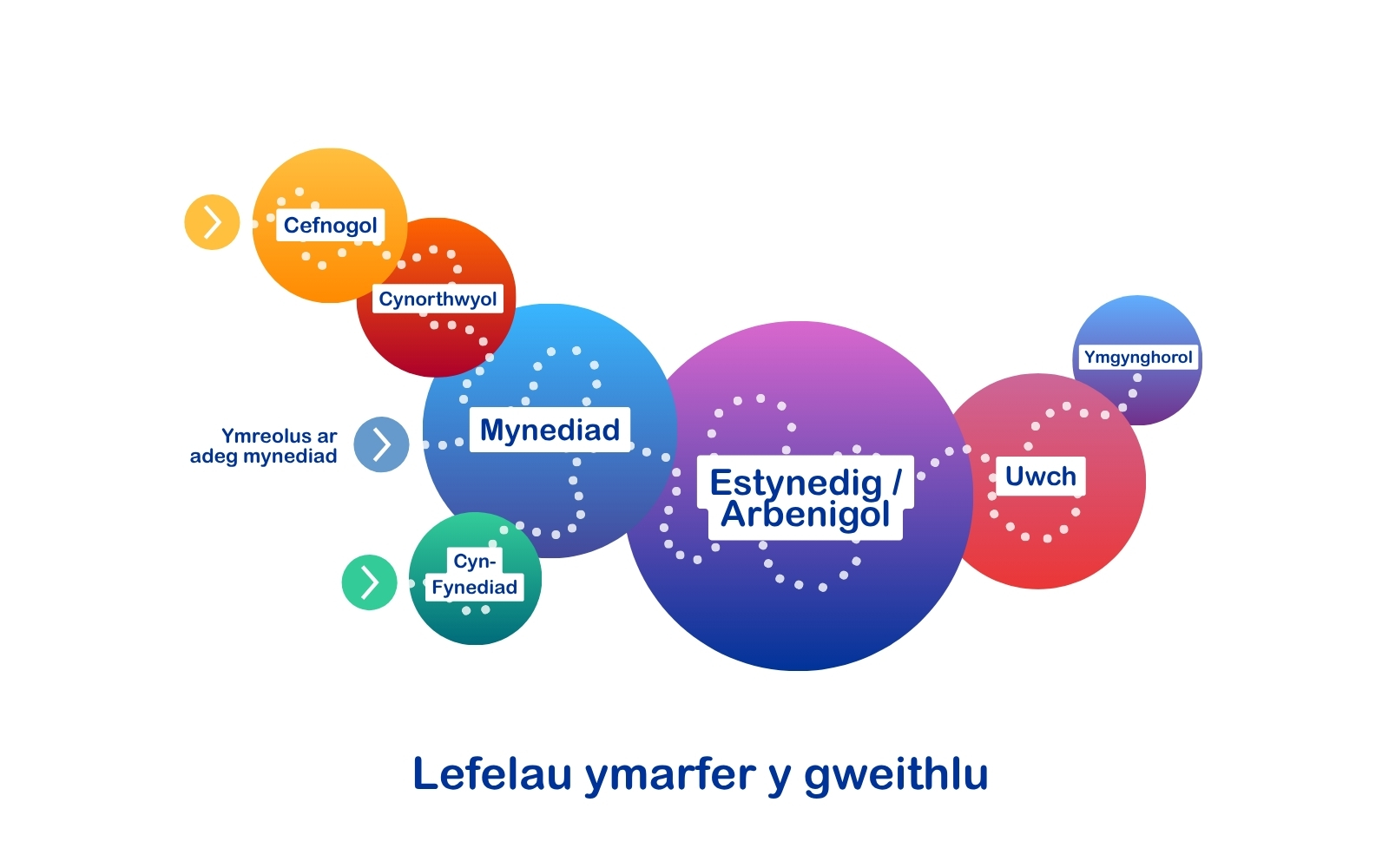
Er mwyn pennu lefel eich ymarfer, bydd angen i chi ddefnyddio eich crebwyll proffesiynol i fapio’ch galluoedd a chwmpas eich ymarfer yn unol â fframweithiau proffesiynol a datblygu gyrfa perthnasol. Gallai fod galluoedd ychwanegol sydd angen cymeradwyaeth gan rai cyflogwyr ac mewn rhai rolau hefyd. Ar y lefelau ymarfer uwch, yn bennaf ar gyfer proffesiynau perthynol i iechyd, mae gan bob un o wledydd y Deyrnas Unedig ei chyhoeddiad ei hun i'ch cefnogi. Mae nifer o gyrff proffesiynol wedi cyhoeddi adnoddau perthnasol hefyd.
Mae cysyniad pedair colofn ymarfer yn gyffredin ar draws nifer o’r adnoddau datblygu’r gweithlu. Nid yw gweithio ar draws y pedair colofn yn ofyniad rheoleiddiol, ond mae modd eu defnyddio i ddiffinio ac egluro cwmpas eich ymarfer a gweithgareddau DPP cysylltiedig. Mae ein cwestiynau cyffredin ac adnoddau lefelau ymarfer uwch yn gallu’ch cefnogi chi yn hyn o beth hefyd.
Pedair colofn ymarfer
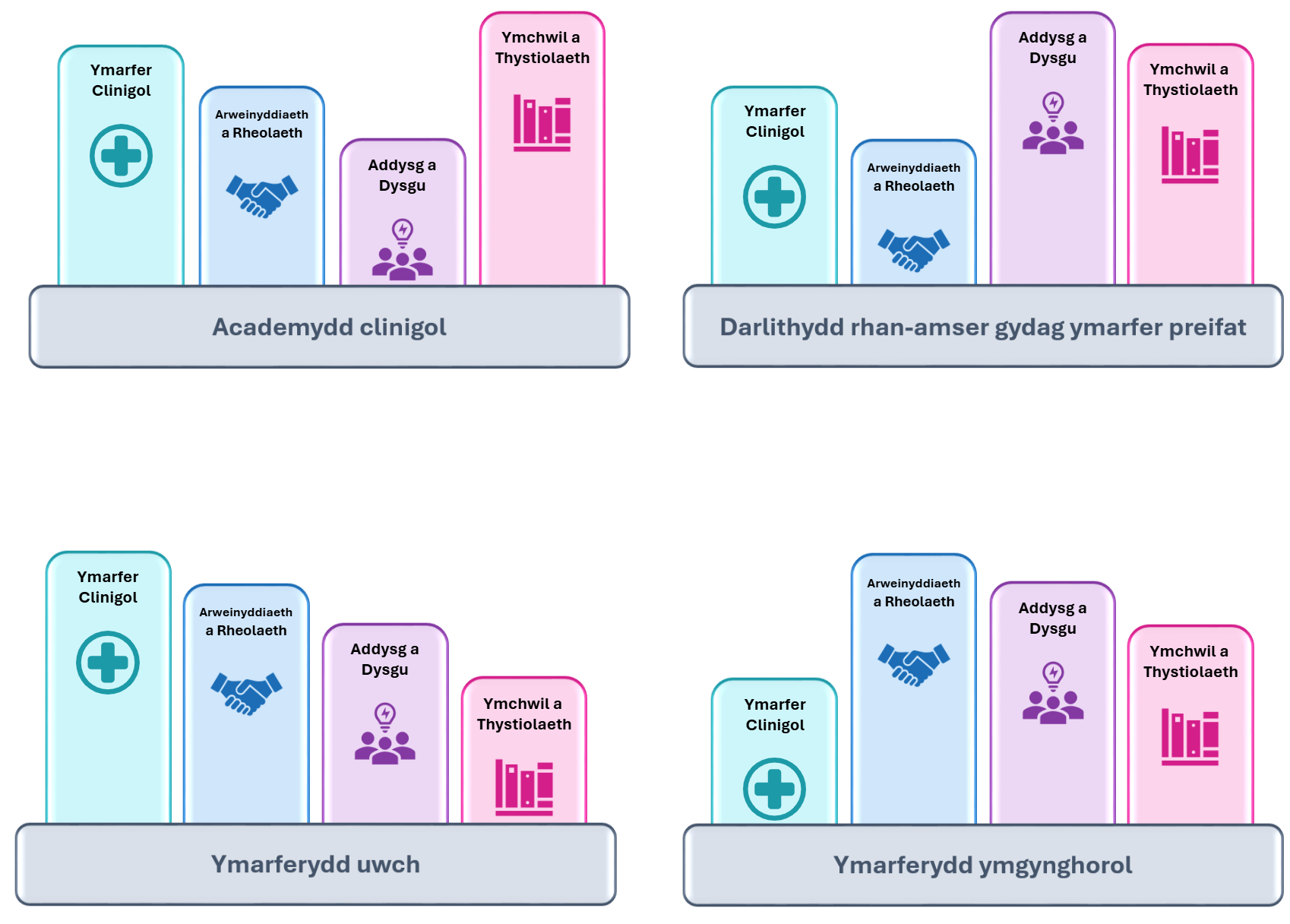
Ceir pedair colofn ymarfer. Fe’u gelwir weithiau yn beuoedd ymarfer yn fframweithiau rhai cyrff proffesiynol. Mae disgwyliad yn y gweithlu y bydd unigolion sy’n gweithio ar lefel ymarfer uwch yn gweithio ar draws y pedair colofn ymarfer:
- Ymarfer clinigol (neu ymarfer proffesiynol)
- Arweinyddiaeth a rheoli
- Addysg a dysgu (neu hwyluso dysgu)
- Ymchwil a thystiolaeth (neu tystiolaeth, ymchwil ac arloesi/datblygu)
Mae’r colofnau hyn yn cynrychioli’r wybodaeth, y sgiliau a’r ymddygiadau sydd eu hangen er mwyn:
- darparu gofal iechyd o safon uchel sy’n ddiogel, yn effeithiol ac yn canolbwyntio ar‑ yr unigolyn (ymarfer clinigol);
- arwain eich hun ac eraill a chyflawni cyfrifoldebau rheoli ac arwain (arweinyddiaeth a rheoli);
- galluogi dysgu effeithiol i’ch hunan ac i eraill yn y gweithle (addysg a dysgu); ac
- ymwneud â gweithgareddau ymchwil a defnyddio’r dystiolaeth er mwyn gwella ymarfer a gwasanaethau (ymchwil a thystiolaeth).
Bydd ‘maint’ pob colofn yn amrywio yn ôl cwmpas eich ymarfer eich hun a’ch rôl/rolau. Gallai’r colofnau gynyddu neu leihau fel cyfran o’ch gweithgareddau yn y gwaith, gan ddibynnu ar natur cynnydd eich gyrfa, er enghraifft, pan fyddwch yn newid eich rôl, fel y gwelir yn yr enghreifftiau eglurhaol.
Teitlau swyddi
Ceir amryw o deitlau swyddi ar draws y lefelau ymarfer uwch. Mae teitlau dynodedig ar gyfer pob proffesiwn yn cael eu gwarchod gan y gyfraith, ond mae teitlau swyddi yn cael eu pennu gan y sefydliad sy’n cyflogi, nid gan y rheoleiddwyr. Mae’r teitlau, y tâl, amodau a thelerau yn amrywio rhwng gwahanol sefydliadau.
Mae’r diffyg eglurder yn y teitlau amrywiol yn gallu peri dryswch i’r cyhoedd, yn enwedig pan nad yw’r teitl gwarchodedig yn rhan o deitl y swydd.
Mae ymdrechion ar y gweill ar draws y Deyrnas Unedig i sicrhau eglurder i unigolion cofrestredig, rheolwyr a sefydliadau ynglŷn â llwybrau tuag at wahanol lefelau ymarfer, ynghyd â’r trefniadau llywodraethu a throsolwg i’w cefnogi. Er enghraifft, mae gwaith yn yr Alban wedi cyflwyno fformat teitlau swyddi cenedlaethol ar gyfer rolau ymarfer uwch gweithwyr proffesiynol perthynol i iechyd yn y GIG er mwyn sicrhau gwell eglurder a chysondeb i’r cyhoedd a’r gweithlu yn ehangach.
Mae eich safonau HCPC yn ei gwneud yn ofynnol i chi weithio er lles defnyddwyr eich gwasanaeth a chyfathrebu yn eglur ac yn onest gyda nhw bob amser.
Rydym yn eich annog i ddefnyddio teitlau swyddi sydd yn helpu defnyddwyr eich gwasanaeth i ddeall beth yw eich gwybodaeth, sgiliau a phrofiad, ac sy’n cynnwys eich proffesiwn neu’ch teitl gwarchodedig.
Rydym yn argymell y dylech drafod unrhyw gwestiynau pellach ynglŷn â theitlau swyddi gyda’ch cyflogwr a/neu gorff proffesiynol.
Cefnogi lefelau ymarfer uwch: rolau yn y system
Un rhan yn unig o’r system sy’n cefnogi lefelau ymarfer uwch ydy rheoleiddwyr statudol fel yr HCPC. Mae ymarfer diogel ac effeithiol yn gyfrifoldeb ar y cyd rhwng yr unigolyn cofrestredig, y rheoleiddwyr (gan gynnwys rheoleiddwyr y system), y sefydliad sy’n cyflogi (lle bo hynny’n berthnasol) a’r corff proffesiynol, gyda phob un ohonynt yn cydweithio o fewn fframwaith cyfreithiol.
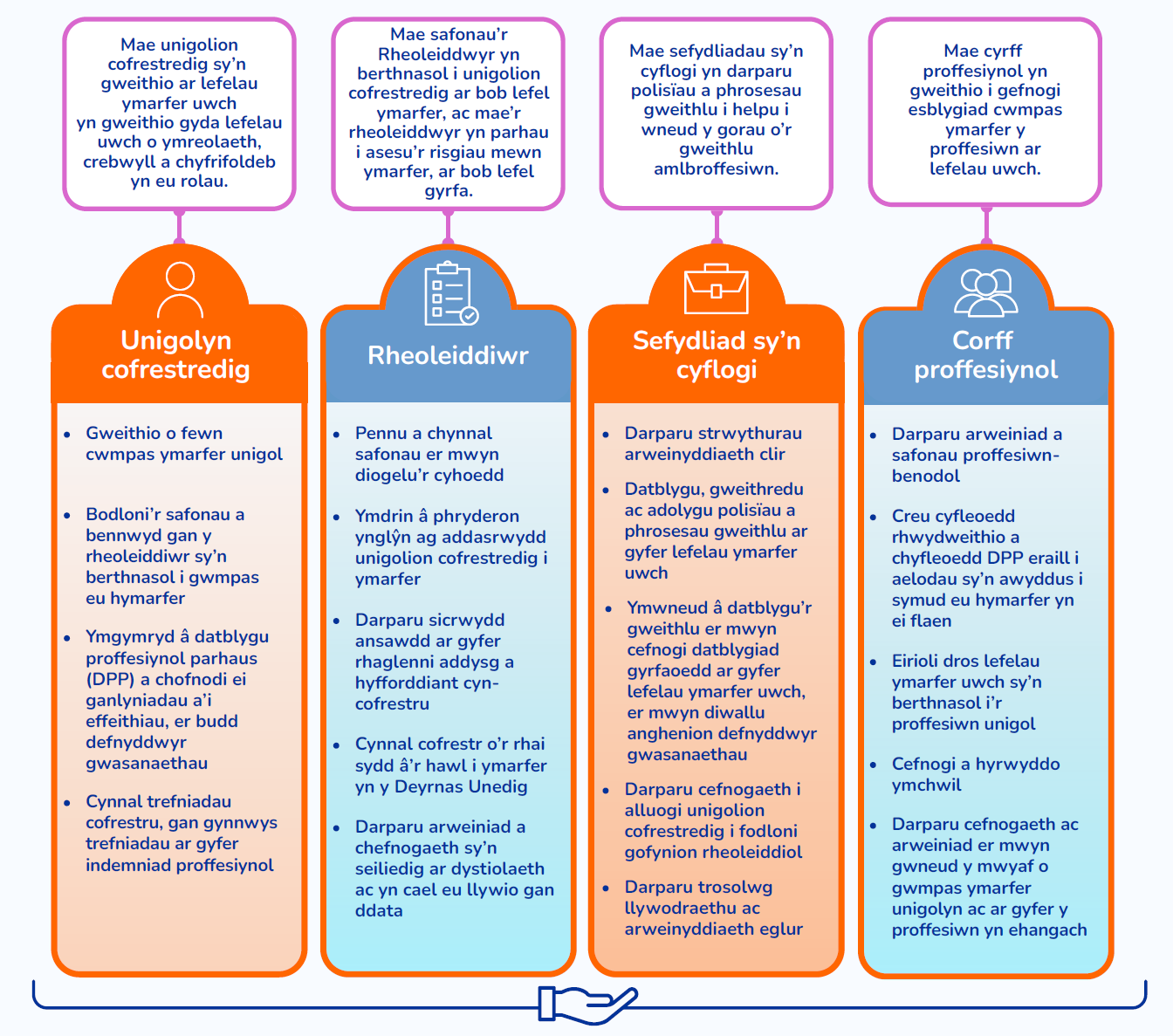
Mae rhagor o wybodaeth am ein rôl yn cefnogi ymarfer diogel ac effeithiol ar lefelau uwch ar ein tudalen Rheoleiddio lefelau ymarfer uwch.
Geirfa - termau allweddol ar gyfer lefelau ymarfer uwch
Dyma restr o dermau a ddefnyddir yn aml wrth drafod lefelau ymarfer uwch. Nid un rheoleiddiwr unigol sydd wedi datblygu’r termau hyn ac maent yn parhau'n hyblyg fel rhan o weithgaredd cynllunio datblygiad gweithlu cyfoes. Mae’n bosib bod gan wahanol genhedloedd y Deyrnas Unedig eu diffiniadau eu hunain sy’n ymateb i’w hanghenion eu hunain o ran gweithlu.
Expand all
-
Mae amlbroffesiwn / amlddisgyblaethol yn cyfeirio at ddull cydweithredol o weithio lle bydd amryw o weithwyr proffesiynol iechyd a gofal yn cydweithio i ddarparu gofal o ansawdd uchel. Mae timau ac amgylcheddau amlbroffesiwn ac amlddisgyblaethol yn pwysleisio pwysigrwydd hyblygrwydd, yn ogystal â gwerth cyfraniadau unigol pob gweithiwr proffesiynol. Nod dulliau amlbroffesiwn ydy gwella canlyniadau i ddefnyddwyr gwasanaethau a gwella effeithiolrwydd cyffredinol darpariaeth iechyd a gofal.
-
Gweler y term ‘corff proffesiynol’.
-
Mae corff proffesiynol yn cynrychioli proffesiwn ac yn gyfrwng ar gyfer cyfleu pryderon a buddiannau’r proffesiwn hwnnw. Bydd cyrff aelodaeth neu broffesiynol yn ymwneud yn aml â diogelu safonau a hyrwyddo ymarfer da, ond nid ydynt yn rheoleiddwyr ac nid oes ganddynt swyddogaeth statudol (gyfreithiol).
-
Ystyr crebwyll proffesiynol ydy defnyddio gwybodaeth a phrofiad sydd wedi’u crynhoi dros amser, yn ogystal â rhesymu beirniadol, er mwyn gwneud penderfyniad proffesiynol ar sail gwybodaeth yng nghyd-destun penodol y sefyllfa. Mae’r gallu i ddefnyddio crebwyll proffesiynol i roi safonau’r HCPC ar waith a gweithio er lles defnyddwyr y gwasanaeth yn elfen hanfodol o fod yn weithiwr proffesiynol ymreolus.
-
Cwmpas ymarfer ydy'r maes neu’r meysydd lle mae gweithiwr proffesiynol yn meddu ar y wybodaeth, y sgiliau a’r profiad i allu ymarfer yn gyfreithlon, yn ddiogel ac yn effeithiol, mewn ffordd sy’n bodloni’r safonau ac nad yw’n creu unrhyw berygl i’r cyhoedd nac iddyn nhw eu hunain. Mae cwmpas ymarfer unigolyn yn debygol o newid dros amser gyda gwybodaeth, sgiliau a phrofiad ychwanegol, ac i rai, cymwysterau ychwanegol.
Mae cwmpas ymarfer yn broses fyw sy’n cynnwys dwy elfen ryngberthynol: unigolyn a phroffesiwn. Bydd y ddwy elfen yn esblygu ac yn newid dros amser. Gallai cwmpas ymarfer unigolyn ymestyn y tu hwnt i’r ffiniau a gydnabyddir yn gyffredinol ar gyfer y proffesiwn gwreiddiol gyda phrofiad, addysg, hyfforddiant a throsolwg sefydliadol priodol.
Rhaid i unrhyw newid mewn cwmpas ymarfer ddigwydd er mwyn diwallu anghenion defnyddwyr gwasanaethau yn effeithiol a rhaid iddo ddigwydd gyda throsolwg a llywodraethu sefydliadol (lle bo hynny’n berthnasol).
-
DPP ydy’r ffordd y mae rhai sy’n gofrestredig yn parhau i ddysgu a datblygu drwy gydol eu gyrfaoedd er mwyn iddynt gadw’u sgiliau a’u gwybodaeth yn gyfoes a gallu ymarfer yn ddiogel ac yn effeithiol. Mae’r HCPC yn gweithredu model DPP sy’n canolbwyntio ar ganlyniadau, sy’n golygu nad yw’r gweithgareddau wedi’u rhagnodi ac nad oes nifer penodol o oriau na gweithgareddau DPP y mae rhaid i unigolion cofrestredig eu cwblhau. Mae angen i unigolion cofrestredig gynnal cofnod o’u gweithgareddau DPP, gan ganolbwyntio ar ganlyniad eu dysgu er budd eu grwpiau eu hunain o ddefnyddwyr gwasanaeth. Mewn rhai gweithleoedd, gallai’r cyflogwr ei gwneud yn ofynnol i unigolion cofrestredig sy’n gweithio ar y lefel ymarfer uwch gofnodi eu gweithgareddau DPP fel rhan o bortffolio proffesiynol.
-
Mae defnyddiwr gwasanaethau yn ymadrodd eang sy’n cyfeirio at unrhyw un sy’n defnyddio, neu’n cael eu heffeithio gan wasanaethau gweithwyr proffesiynol sy’n gofrestredig gyda’r HCPC. Gallai hynny gynnwys cleifion, teuluoedd, gofalwyr, myfyrwyr a dysgwyr, cydweithwyr, pobl y mae unigolyn cofrestredig yn rheolwr llinell arnynt, a mwy.
-
Mae dirprwyo'n golygu gofyn i rywun gyflawni gweithgaredd ar eich rhan. Mae’n golygu aseinio gweithgaredd i rywun arall sydd â’r wybodaeth, y sgiliau a’r profiad angenrheidiol i allu ei gyflawni’n ddiogel ac yn effeithiol. Rhaid i’r unigolyn sy’n derbyn y gweithgaredd a ddirprwyir barhau i dderbyn goruchwyliaeth a chefnogaeth briodol, gan atgyfnerthu’r ffaith bod dirprwyo yn weithgaredd perthynol.
-
System strwythuredig ydy fframwaith datblygu gyrfa sy’n mapio sut y gall gweithwyr proffesiynol dyfu o fewn eu gyrfaoedd. Mae gan nifer o gyrff proffesiynol fframweithiau penodol ar gyfer eu proffesiwn sy’n amlinellu’r wybodaeth, y sgiliau a’r profiadau y gall aelodau, unigolion cofrestredig a rheolwyr eu defnyddio wrth gynllunio gweithgareddau datblygu proffesiynol parhaus. Gweler hefyd y term ‘pedair colofn ymarfer’.
-
Mae goruchwylio yn elfen greiddiol er mwyn cynnal ymarfer diogel ac effeithiol yn yr holl sectorau a lleoliadau. Mae’n broses o ddysgu a datblygu proffesiynol sy’n galluogi unigolion i fyfyrio am a datblygu eu gwybodaeth a’u sgiliau drwy gefnogaeth reolaidd y cytunwyd arni gan weithiwr proffesiynol arall.
-
Mae AHPs yn ddosbarthiad a ddefnyddir i ddisgrifio amryw o broffesiynau a reoleiddir gan yr HCPC neu gan y Cyngor Osteopatheg Cyffredinol (GOsC). Ymhlith y proffesiynau perthynol i iechyd, mae therapyddion celf, deietegwyr, therapyddion drama, therapyddion cerdd, therapyddion galwedigaethol, ymarferwyr adrannau llawfeddygol, orthoptyddion, parafeddygon, ffisiotherapyddion, podiatryddion, prosthetyddion ac orthotyddion, radiograffyddion, a therapyddion iaith a lleferydd. Fodd bynnag, ceir amrywiadau rhwng gwahanol wledydd y Deyrnas Unedig, er enghraifft, dim ond yn Lloegr y caiff osteopathiaid eu hystyried yn AHPs ac mae radiograffyddion ac ymarferwyr adrannau llawfeddygol yn cael eu hystyried yn wyddonwyr gofal iechyd yng Nghymru.
-
Mae angen i unigolion cofrestredig gael trefniant indemniad proffesiynol ar waith fel amod ar gyfer cofrestru gyda’r HCPC. Rhaid i’r trefniant ddarparu yswiriant sy’n addas ar gyfer ymarfer yr unigolyn cofrestredig, gan ystyried natur a graddfa'r risg. Bydd angen iddo fod yn ddigonol i ddiwallu unrhyw atebolrwydd a allai godi petai hawliad yn eich erbyn yn llwyddiannus. I gael rhagor o wybodaeth, ewch i dudalennau gwe’r HCPC.
-
Mae ymarfer arbenigol yn lefel ymarfer a ddiffinnir fel rhan o strwythur gweithlu yn yr Alban a Gogledd Iwerddon. Yng Nghymru a Lloegr, defnyddir y term ‘estynedig’ i ddisgrifio’r un lefel ymarfer (gweler hefyd y term ‘lefel estynedig’). Mae wedi’i lleoli islaw’r lefelau ymarfer uwch ac ymgynghorol. Bydd gweithwyr proffesiynol sy’n gweithio ar y lefel ymarfer arbenigol yn defnyddio amrywiaeth eang o deitlau swyddi ac maent yn weithwyr proffesiynol cofrestredig profiadol sy’n ymgymryd â gwaith cymhleth ac yn rheoli risgiau o ddydd i ddydd. Yn yr un modd â’r lefelau ymarfer uwch eraill, mae gweithwyr proffesiynol ar lefel ymarfer arbenigol yn gweithio mewn lleoliadau niferus.
Gall lefel ymarfer arbenigol fod yn sylfaen ar gyfer symud ymlaen i ymarfer uwch, neu gall fod yn gyrchfan gwerthfawr yn y gweithle ynddi’i hun, gan gynnig lefel gyson o arbenigedd i wasanaethau a defnyddwyr gwasanaethau.
-
Mae ymarfer estynedig yn lefel ymarfer a ddiffinnir fel rhan o strwythur gweithlu yng Nghymru a Lloegr. Yn yr Alban a Gogledd Iwerddon, defnyddir y term ‘arbenigol’ i ddisgrifio’r un lefel ymarfer (gweler hefyd y term ‘lefel arbenigol’). Mae wedi’i lleoli islaw’r lefelau ymarfer uwch ac ymgynghorol. Bydd gweithwyr proffesiynol sy’n gweithio ar y lefel ymarfer estynedig yn defnyddio amrywiaeth eang o deitlau swyddi ac maent yn weithwyr proffesiynol cofrestredig profiadol sy’n ymgymryd â gwaith cymhleth ac yn rheoli risgiau o ddydd i ddydd. Yn yr un modd â’r lefelau ymarfer uwch eraill, mae gweithwyr proffesiynol ar lefel ymarfer estynedig yn gweithio mewn lleoliadau niferus.
Gall ymarfer estynedig fod yn sylfaen ar gyfer symud ymlaen i ymarfer uwch, neu gall fod yn gyrchfan gwerthfawr yn y gweithle ynddi’i hun, gan gynnig lefel gyson o arbenigedd i wasanaethau a defnyddwyr gwasanaethau.
-
Un o’r lefelau ymarfer uwch, sydd wedi’i lleoli rhwng estynedig/arbenigol ac ymgynghorol.
Mae’r diffiniad canlynol wedi’i gytuno ar draws pedair gwlad y Deyrnas Unedig yn y datganiad ‘Ymarfer uwch yn y Proffesiynau Perthynol i Iechyd (AHPs)’ er mwyn rhoi eglurder ynglŷn â’r ffordd y caiff ymarfer uwch i AHPs ei ddiffinio:
“Mae ymarfer uwch yn y proffesiynau perthynol i iechyd yn golygu gwneud penderfyniadau cymhleth, wedi’u sylfaenu ar ddyfarniad ôl-gofrestru ar lefel meistr neu gyfatebol a gyflawnwyd gan ymarferydd profiadol ac sy’n ymgorffori pob un o’r pedair colofn ymarfer: ymarfer clinigol, arweinyddiaeth a rheolaeth, addysg, ac ymchwil. Mae’n cael ei ddarparu gan weithwyr proffesiynol iechyd a gofal galluog a phrofiadol sydd â lefel sylweddol o ymreolaeth, crebwyll a chyfrifoldeb yn eu rolau.
Mae ymarferwyr uwch yn rheoli gofal cymhleth mewn partneriaeth ag unigolion, teuluoedd a gofalwyr, gan ddadansoddi a syntheseiddio problemau cymhleth, a hynny’n aml yn rhan o dimau amlddisgyblaethol. Maent yn delio â risgiau ac ansicrwydd clinigol ar draws meysydd gwaith arwyddocaol, mewn lleoliadau amrywiol, gan ddatblygu datrysiadau arloesol er mwyn hwyluso mynediad at ofal, sicrhau’r profiadau gorau i bobl, hybu iechyd ac atal afiechyd a gwella canlyniadau.”
Ni ddylid drysu’r term ‘ymarfer uwch’ â’r ymadrodd ‘lefelau ymarfer uwch’, sy’n cyfeirio at dair lefel ymarfer, sef estynedig/arbenigol, uwch ac ymgynghorol.
-
Strwythurau i’r gweithlu ydy lefelau ymarfer ac nid ydynt yn lefelau rheoleiddiol ffurfiol. Mae safonau rheoleiddiol yn berthnasol ar draws pob lefel ymarfer i unigolion cofrestredig (gweler hefyd y term ‘lefelau ymarfer uwch’).
-
Mae’r lefelau ymarfer uwch yn cynnwys tair lefel, sef estynedig/arbenigol, uwch ac ymgynghorol. Mae fframweithiau proffesiynol ar waith ym mhob un o bedair cenedl y Deyrnas Unedig i gefnogi datblygiad y gweithlu profiadol. Mae’r derminoleg yn amrywio ychydig ar draws y Deyrnas Unedig, er enghraifft, defnyddir ‘arbenigol’ yn yr Alban a Gogledd Iwerddon, ond yng Nghymru a Lloegr, defnyddir ‘estynedig’ i ddisgrifio’r un lefel ymarfer. Ceir amryw o rolau ar bob lefel (gweler hefyd y term ‘lefelau ymarfer’).
-
Y lefel ymgynghorol ydy’r lefel uchaf yn strwythur datblygu’r gweithlu, uwchben y lefelau ymarfer estynedig/arbenigol ac uwch. Er nad oes diffiniad sydd wedi’i gytuno’n ganolog ar draws pedair cenedl y Deyrnas Unedig, mae gweithwyr proffesiynol sy’n gweithio ar y lefel ymarfer ymgynghorol yn gweithio ar draws y pedair colofn ymarfer (a elwir yn beuoedd weithiau) ac yn darparu ymgynghoriaeth. Yn Lloegr, mae’r lefel ymarfer ymgynghorol yn cynnwys:
- Ymarfer arbenigol: helpu i sefydlu ymarfer proffesiynol sy’n seiliedig ar werthoedd ar draws gwahanol lwybrau, gwasanaethau, sefydliadau a systemau, gan weithio gydag unigolion, teuluoedd, gofalwyr, cymunedau ac eraill
- Arweinyddiaeth strategol sy’n galluogi: darparu arweinyddiaeth sy’n seiliedig ar werthoedd ar draws y llwybr gofal, gwasanaethau a systemau mewn sefyllfaoedd cymhleth a chyfnewidiol
- Dysgu, datblygu a gwella ar draws y system: datblygu potensial staff, ychwanegu at, a thrawsnewid y gweithlu, helpu pobl i ddysgu, datblygu a gwella (mewn ymarfer ac o ymarfer), hyrwyddo rhagoriaeth
- Ymchwil ac Arloesi: datblygu diwylliant ‘cyfoethog o ran gwybodaeth ac ymchwilgar’ ar draws y gwasanaeth a’r system sy’n cyfrannu at gael allbynnau ymchwil yn hyrwyddo effaith gadarnhaol ar ddatblygiad ac ansawdd o ran arloesi a gwella galluoedd ymhlith staff a systemau
- Ymgynghoriaeth ar draws 1-4 ar draws y system: defnyddio dulliau a chyfleoedd ymgynghorol sy’n cael yr effaith fwyaf posib ar ymarfer, gwasanaethau, cymunedau a phoblogaethau, ac sydd yn ychwanegu at alluoedd a chapasiti’r gweithlu ac yn eu cynnal
-
Mae optimeiddio cwmpas yn golygu canfod ffyrdd o wneud y defnydd gorau o’r gweithlu cyfan ar bob lefel ymarfer, o safbwynt eu hamser, eu gwybodaeth a’u sgiliau, er budd defnyddwyr gwasanaethau. Gellir cyflawni optimeiddio cwmpas drwy ddirprwyo effeithiol ar draws yr holl weithlu (gan gynnwys dirprwyo i'r gweithlu ategol).
-
Strwythur ar gyfer gweithlu ydy’r pedair colofn ymarfer ac maent yn cwmpasu ymarfer clinigol, arweinyddiaeth a rheolaeth, addysg, ac ymchwil. Mae’r colofnau wedi'u mabwysiadu mewn nifer o adnoddau, gan gynnwys fframwaith datblygu gyrfaoedd gan gyrff proffesiynol, ar gyfer pob lefel gyrfa. Mae disgwyliad yn y gweithlu y bydd gweithwyr proffesiynol sy’n gweithio ar lefelau ymarfer uwch ac ymgynghorol yn gweithio ar draws pob un o’r pedair colofn (gweler hefyd y termau ‘lefel ymgynghorol’ a ‘lefel uwch’).
-
Mae CAHPO mewn swydd ym mhob un o bedair cenedl y Deyrnas Unedig. Nhw yw’r arweinydd proffesiynol sy’n gyfrifol am gynghori’r llywodraethau ynglŷn â materion sy’n effeithio ar AHPs. Maen nhw’n goruchwylio cyfeiriad strategol y proffesiynau AHP, ar draws pob lefel ymarfer, ac maen nhw’n gweithio’n agos gyda rheoleiddwyr iechyd a gofal.
Y swydd sy’n cyfateb i’r CAHPOs ar gyfer proffesiynau gwyddonwyr gofal iechyd ydy’r Prif Swyddog Gwyddonol. -
Prif nod rheoleiddiwr ydy amddiffyn y cyhoedd. Mae’r HCPC yn rheoleiddiwr statudol sy’n cyflawni swyddogaethau cyfreithiol mewn perthynas â phroffesiwn (neu broffesiynau). Mae’r HCPC yn rheoleiddio 15 proffesiwn iechyd a gofal yn y Deyrnas Unedig ac yn diogelu’r cyhoedd drwy bennu safonau ar gyfer addysg a hyfforddiant ac ymarfer gweithwyr proffesiynol, cymeradwyo rhaglenni y mae rhaid i weithwyr proffesiynol eu cwblhau er mwyn cofrestru gyda’r rheoleiddiwr, cadw cofrestr o weithwyr proffesiynol (sef yr unigolion cofrestredig) sydd yn bodloni’r safonau a chymryd camau gweithredu os na fydd gweithwyr proffesiynol sydd ar y Gofrestr yn bodloni’r safonau.
-
Disgwyliadau ydy safonau rheoleiddiol, sy’n cael eu pennu gan reoleiddwyr, fel yr HCPC, ac y mae rhaid i unigolion a reoleiddir eu bodloni. Mae safonau rheoleiddiol yn gorwedd ochr yn ochr â chyfreithiau a chanllawiau eraill er mwyn sicrhau ymarfer diogel ac effeithiol. Mae safonau’r HCPC yn cynnwys:
Y safonau hyfedredd: Mae’r rhain yn pennu disgwyliadau eglur ar gyfer gwybodaeth a galluoedd unigolion cofrestredig pan fyddant yn dechrau ymarfer, ac mae rhaid i bob unigolyn cofrestredig fodloni’r safonau hyn er mwyn ymuno â Chofrestr yr HCPC. Unwaith y byddant ar y Gofrestr, rhaid i’r rhai sydd wedi cofrestru barhau i fodloni’r safonau hyfedredd sy’n berthnasol i gwmpas eu hymarfer.
Y safonau ymddygiad, perfformiad a moeseg: Mae’r rhain yn pennu disgwyliadau ar gyfer ymddygiad unigolion cofrestredig a’r hyn y gall y cyhoedd ei ddisgwyl gan weithiwr proffesiynol iechyd a gofal, a dyma’r fframwaith moesegol y mae rhaid i’r holl unigolion cofrestredig weithio oddi mewn iddo. Mae’r safonau hyn yn helpu i lywio penderfyniadau ynglŷn â chymeriad gweithwyr proffesiynol sy’n ymgeisio i fod ar Gofrestr yr HCPC, ac maent yn cael eu defnyddio pan fydd pryder yn cael ei godi ynglŷn ag ymarfer unigolyn cofrestredig.
Y safonau datblygiad proffesiynol parhaus: Mae’r rhain yn pennu disgwyliadau ynghylch dangos dysgu a datblygu parhaus. Rhaid i unigolion cofrestredig fodloni’r safonau hyn wrth ymgymryd â gweithgareddau DPP, ac maent yn cael eu defnyddio pan fydd awdit DPP yn cael ei gynnal.
Y safonau sy’n berthnasol i addysg a hyfforddiant: Mae'r rhain yn pennu disgwyliadau ar gyfer y ffordd y dylai rhaglenni addysg a hyfforddiant baratoi dysgwyr ar gyfer ymarfer proffesiynol. Caiff y safonau hyn eu defnyddio i asesu rhaglenni addysg a hyfforddiant a chymeradwyo rhaglenni addas fydd yn gwneud graddedigion llwyddiannus yn gymwys i ymgeisio i fod ar Gofrestr yr HCPC.
-
Mae'r term hwn yn cwmpasu’r holl feysydd lle mae unigolion cofrestredig yn gweithio, gan gynnwys lleoliadau iechyd a gofal y sector cyhoeddus, sefydliadau academaidd, y trydydd sector, y sector preifat a llawer mwy.
-
Mae’r term system-gyfan yn cyfeirio at ddull gweithio sy’n digwydd ar draws system gyfan yn hytrach nag mewn lleoliadau neu sectorau unigol. Mae’n arwydd bod newidiadau, polisïau neu effeithiau yn berthnasol ac i’w cymhwyso ar draws pob elfen o system.
-
Gallai’r gair teitl gyfeirio at deitl swydd rôl benodol, neu at y teitlau dynodedig ar gyfer proffesiynau sydd wedi’u gwarchod gan y gyfraith. Teitlau gwarchodedig ydy’r teitlau dynodedig y mae'r hawl i weithwyr proffesiynol eu defnyddio wrth ymarfer yn y Deyrnas Unedig yn gyfyngedig i’r rhai sydd ar y gofrestr berthnasol a gynhelir gan reoleiddiwr statudol, fel yr HCPC. Mae’r HCPC yn rheoleiddio teitlau gwarchodedig ar gyfer 15 proffesiwn.
Mae teitlau swyddi’n cael eu pennu gan y sefydliadau sy’n cyflogi ac maent yn gallu amrywio rhwng sectorau a sefydliadau. Gallai’r teitlau hyn gynnwys teitl dynodedig/gwarchodedig eich proffesiwn a lefel eich ymarfer. Heblaw am y defnydd o deitlau gwarchodedig, nid yw’r rheoleiddiwr yn pennu nac yn cyfyngu ar y teitlau y gall gweithiwr proffesiynol eu harddel wrth weithio.
-
Strwythurau a phrosesau ydy trefniadau llywodraethu, ac maent yn arwain, yn cyfarwyddo, ac yn rheoli ansawdd y gwasanaeth. Gallai hynny gynnwys adnabod a lleihau risgiau, sicrhau y caiff y safonau gofynnol eu cyflawni, ac ymchwilio i berfformiad sydd islaw’r safon ofynnol. Ymhlith y ffyrdd y maent yn cyflawni hyn, mae hyfforddiant gorfodol i staff, asesu perfformiad a rhannu arferion gorau. Mae trefniadau llywodraethu yn hanfodol er mwyn sicrhau y caiff gwasanaethau iechyd a gofal cynaliadwy sydd o safon uchel eu darparu.
-
Unigolyn cofrestredig ydy unigolyn sydd ar Gofrestr y rheoleiddiwr perthnasol ar gyfer eu proffesiwn ar y pryd, sef yr HCPC yn yr achos hwn.
-
Un o blith nifer o rolau ar lefel ymarfer uwch ydy ACP. Daw ACPau o blith amryw o broffesiynau a reoleiddir gan yr HCPC a phroffesiynau eraill, gan gynnwys nyrsio, bydwreigiaeth, osteopatheg a fferylliaeth. Gweler y term ‘lefel uwch’ hefyd am ddisgrifiad cyffredinol o’r wybodaeth, y sgiliau a’r profiadau sy’n sail i bob rôl ar lefel ymarfer uwch, gan gynnwys ACP.
Cynnwys cysylltiedig




Adnoddau amlbroffesiwn
- Yn Lloegr, mae gan y Centre for Advancing Practice nifer o adnoddau ar gyfer y lefelau ymarfer estynedig, uwch ac ymgynghorol, gan gynnwys fframweithiau galluoedd, egwyddorion a chanllawiau ar gyfer goruchwylio ac astudiaethau achos sy'n cynnwys ymarferwyr ar y lefelau ymarfer uwch.
- Mae gan lwyfan dysgu GIG yr Alban, Turas becyn cymorth penodol ar gyfer ymarfer Uwch. Mae’r adnoddau’n cynnwys goruchwylio mewn gweithleoedd gwledig, dysgu ar draws y pedair colofn ymarfer, ac enghreifftiau o ymarfer. Mae fframwaith datblygu nyrsio, bydwreigiaeth a phroffesiynau perthynol i iechyd (NMAHP) yn cynnig dull strwythuredig o ganfod cyfleoedd DPP ar ôl cofrestru.
- Mae Addysg a Gwella Iechyd Cymru wedi cyhoeddi fframwaith proffesiynol ar gyfer ymarfer clinigol estynedig, uwch ac ymgynghorol.
- Mae Adran Iechyd Gogledd Iwerddon wedi cyhoeddi’r fframwaith ymarfer AHP Uwch.
- Ceir adnoddau hefyd sy’n canolbwyntio ar golofnau ymarfer unigol megis Fframwaith Gyrfa Addysgwr AHP y Cyngor Deoniaid Iechyd a Fframwaith galluoedd ymchwil amlbroffesiwn seiliedig ar iechyd GIG Lloegr.
- Enghreifftiau yw’r rhain o lyfrgell fwy o adnoddau, gan gynnwys rhai gan gyrff proffesiynol, sy’n gallu cynorthwyo unigolion cofrestredig i adnabod lefel eu hymarfer a meysydd ar gyfer DPP er mwyn parhau i dyfu cwmpas eu hymarfer mewn modd priodol.