
All registrants working at advanced levels are fully regulated and must meet all regulatory standards which are relevant to their scope of practice
The HCPC and General Osteopathic Council (GOsC) have collaborated to produce a Shared Update for registrants working at or towards advanced levels of practice in a range of sectors and settings, and for the multiprofessional managers, strategic leaders, colleagues and academics who support the development of this experienced and highly skilled workforce.
You can view or download the full update below.
Audience
This update is for a range of audiences including but not limited to:
- registrants aspiring to or working at advanced levels of practice;
- line managers of registrants aspiring to or working at advanced levels of practice, across sectors;
- operational and strategic managers such as Advanced Practice Leads in NHS Trusts, Chief Allied Health Professional (AHP) Leads, Chief Nurses, Chief Healthcare Scientist (HCS) Leads;
- colleagues in multiprofessional teams seeking to understand the nature of advanced levels of practice for Health and Care Professions Council (HCPC) registrants and General Osteopathic Council (GOsC) registrants; or
- registrants and other colleagues working in Higher Education Institutes supporting the development of the workforce.
Key messages
- All HCPC and GOsC registrants working at advanced levels are already fully regulated and must meet all regulatory standards which are relevant to their scope of practice
- Service user safety is a shared responsibility. Registrants, regulators, employers, professional bodies, unions and others play important and different roles in ensuring safety
- The HCPC and GOsC do not set or limit the scope of practice of registrants but it is essential for registrants to use their professional judgement to work within their scope to ensure they practice safely, lawfully and effectively
The HCPC and GOsC have collaborated to produce this Shared Update for registrants working at or towards advanced levels of practice in a range of sectors and settings, and for managers (registrant and multiprofessional), strategic leaders, colleagues and academics who support the development of this experienced and highly skilled workforce.
The update clarifies the existing position on regulation of advanced levels of practice and reinforces how HCPC and GOsC registrants working at these levels can continue to meet their existing standards across a range of job titles, sectors and settings.
This update navigates professional regulatory standards at advanced levels of practice, with a particular focus on scope of practice / scope optimisation, continuing professional development, delegation and supervision, to make the most of this workforce to benefit service users.
The content in this update was originally developed for a webinar series commissioned by NHS England and co-hosted by HCPC and GOsC. Discussions with registrants, managers, strategic leaders, academics and professional bodies colleagues informed the webinar content.
It also sits alongside the Four UK countries statement on advanced practice in the Allied Health Professions (AHPs) written by the Chief Allied Health Professions Officers, with the update covering the broader career and workforce development trajectory outlined in the statement (Annex A, section 5), namely enhanced/specialist, advanced and consultant.
In this update, HCPC and GOsC use ‘advanced levels of practice’ as an umbrella term to include the three distinct levels of practice for experienced registrants: namely ‘enhanced’/’specialist’, ‘advanced’ and ‘consultant’.
The terminology used in this Shared Update reflects contemporary discussions. However, this is an area of workforce development where terms vary across sectors and UK countries, and they may also continue to evolve. A glossary of the current key terms and definitions is available.
Further resources for advanced levels of practice
Existing HCPC and GOsC regulatory arrangements: from education to registration through to advanced levels of practice
Pre-registration qualifications, to gain entry to the registers, are delivered through education programmes approved by the regulators. There are multiple routes to be awarded these qualifications including via the apprenticeship route.
Some registrants will enter the workforce through pre-registration master’s or doctoral routes. They will still need to build their capability and experience over time in their practice, and be required to undertake further post-registration learning, training and, for some, additional qualifications, to demonstrate they are working at advanced levels of practice.
At the point of registration, all registrants are expected to practise as autonomous professionals, exercising their own professional judgement. They must continue to meet the professional standards of their regulator, actively participate in supervision, have in place a professional indemnity arrangement for their practice (which meets their regulator’s requirements) and undertake continuing professional development relevant to their scope of practice, participating in periodic audits when required.
HCPC and GOsC registrants, regardless of the level they practise at, are already regulated. There are systems in place to maintain safe and effective practice, ranging from outcomes-based standards, to fitness to practise processes and sanctions. In serious cases this can include removing a registrant from the register and therefore from practice.
The role of regulators is to protect the public. The HCPC and GOsC continue to assess the risks in practice, at all career levels, adopting the right-touch regulation approach from the Professional Standards Authority. This approach involves looking at the level of risk of harm and choosing the most effective and proportionate response, whether through regulation or other actions.
The HCPC and GOsC do not set or limit the scope of practice of any registrants—to do so may unnecessarily hinder how multidisciplinary teams work together and how roles and services develop over time. Experienced registrants will work with increasing levels of autonomy, for example, at the advanced level of practice, professionals are expected to exercise significant autonomy, judgement and responsibility in their roles.
Regulation is one part of a broader safety picture. The registrant, the regulators, employing organisations (where appropriate) and professional bodies all play a proactive role in ensuring safe and effective practice working within a legal framework.
A system-wide approach, for example, clinical governance arrangements that employers have in place, remains another important safety measure for all levels of practice.
How the standards apply to registrants working at advanced levels of practice
In this section we set out how outcomes-based regulation works and why it isn’t prescriptive.
The regulatory standards are designed to apply to registrants working in all roles across settings, including in clinical and professional practice, academic, leadership, management and research roles. When the standards refer to service users, this means the broad range of people who are affected by the professional services of registrants such as, patients, families, carers, students and learners, colleagues, people who are line-managed by a registrant and more.
The HCPC and GOsC both adopt the same approach to protecting the public through outcomes-based regulation (OBR). This emphasises the importance of focusing on the results and impact of registrant services, rather than the processes used.
The OBR approach is one of the reasons the standards are not designed as a list of regulated activities (input-focused). Additionally, a focus on compliance to a list of processes could stifle innovation and reduce the agility of regulated professions to respond efficiently to meet the ever-changing needs of people and populations.
OBR encourages regulators to work in collaboration with a wide range of organisations and people, acknowledging that regulation is one part of a broader safety picture.
You can refer to Meeting the standards for more information.
Defining advanced levels of practice
In this section we define the three levels of practice (enhanced/specialist, advanced, consultant) which form a career and workforce development framework on completion of the earlier career stages.
The three advanced levels of practice are enhanced / specialist, advanced, and consultant. For registrants, the levels of practice may help to identify their scope of practice and areas for continuing professional development, as they continue to work as autonomous practitioners.
The wording for the advanced levels of practice differs slightly across the UK countries. ‘Specialist’ is used in Scotland and Norther Ireland but in England and Wales the same level is described as ‘enhanced’. The overall approaches, including the descriptions of each level of practice are closely aligned.
There are many different roles and job titles across sectors at these levels of practice. Some roles remain within individual professions, and some are in multiprofessional roles.
The definitions of the advanced levels of practice (enhanced/specialist, advanced and consultant) originate in the national health sectors across the UK so may feel less familiar to registrants working in roles across the broader health and care system. However, the terminology, or variations of it, has been widely adopted in resources relevant to registrants working across sectors. For example, the levels of practice feature in some career development frameworks from professional bodies.
The levels of practice are not a regulatory requirement. They have been developed as part of ongoing work to provide clarity about career progression, and to support the education, training, governance and organisational oversight that is needed to support role development for experienced health and care professionals.
More information about What are advanced levels of practice?
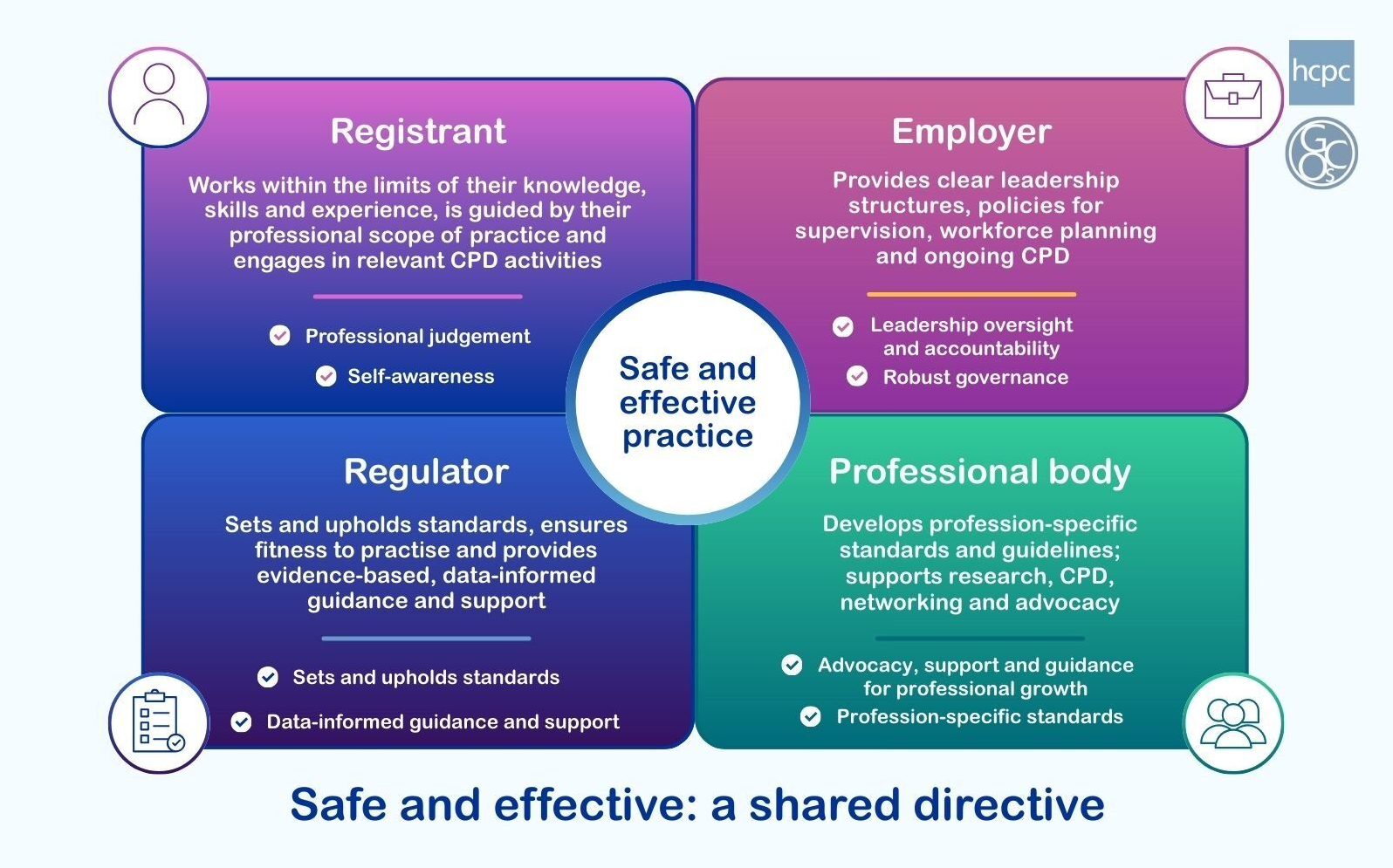
Safe and effective practice is a shared directive for advanced levels of practice
In this section, we reinforce that a proactive system-wide approach is needed to make healthcare safe and effective and outline requirements to show what that looks like in practice.
Professional regulation is part of a broader safety picture and on its own does not guarantee safe practice, including at advanced levels of practice.
The HCPC and GOsC set standards for our registrants in order to protect the public. These standards ensure registrants receive the education necessary to gain entry to their register and set the ethical framework they must meet while registered.
Safe and effective practice is a shared responsibility between registrants, health and care regulators (professional health healthcare regulators like the HCPC and GOsC and system regulators), employing organisations (where appropriate) and professional bodies, all working together within a legal framework.
Employing organisations must ensure they have in place:
- clear leadership oversight and accountability for the workforce;
- a consistent understanding of advanced levels of practice including at the operational level;
- workforce policies and processes to support advanced levels of practice including for supervision; delegation and scope optimisation
- robust workforce planning including service design and deployment;
- consistent support for the workforce including education, training and supervision to meet regulatory requirements;
- job descriptions that map against the four pillars of practice; and
- defined scopes of practice that are reviewed at regular intervals.
Professional bodies provide profession-specific guidance and support including in relation to scope of practice, advocacy and advice, research, and support for professional growth and continuing professional development.
Professional body membership may include professional indemnity arrangements, although in some instances registrants may need to make additional arrangements depending on their individual scope of practice.
Defining scope of practice: individual and profession
In this section, we cover scope of practice and the two inter-related elements: individual and profession. Links are made between professional judgement, scope of practice and arrangements for professional indemnity.
Scope of practice refers to the range of responsibilities and activities that a registrant is qualified and capable to perform based on their education, training and experience.
As set out above, outcomes-based regulation means that HCPC and GOsC do not set or limit a registrant’s scope of practice. It is essential for registrants to use their professional judgement to work within their scope to ensure they practise safely, lawfully and effectively.
Scope of practice is a living process comprising two inter-related elements: individual scope of practice and profession scope of practice. Both evolve and change over time.
An individual’s scope of practice may extend beyond the generally accepted boundaries of the origin profession with appropriate experience, education, training and organisational oversight.
Of central importance is that registrants, managers and organisations must be able to articulate and evidence their individual and profession’s scope of practice, including how they work to effectively meet service user needs, and the knowledge, skills and qualifications gained to do so.
You can download a reflective template to help define and explain your scope of practice at advanced levels of practice.
Registrants must ensure they have professional indemnity arrangements in place and that it provides the appropriate level of cover, including for their individual scope of practice.
Scope of practice, continuing professional development (CPD) and service user needs
This section explains how registrants meet their registration renewal and CPD requirements while working at advanced levels of practice.
Registrants at advanced levels of practice will continue to develop across all four pillars of practice (clinical practice, education, leadership and research) relevant to their individual and profession’s scope of practice.
Professional bodies, working in conjunction with regulators, support the evolution of a profession’s scope of practice.
Individual registrants must evidence how their CPD supports them to appropriately evolve their scope of practice to meet service user needs (recognising that the term ‘service user’ is broad).
CPD and lifelong learning is each person’s responsibility and needs to be made possible and supported by employers including time being allocated in supervision to identify ongoing learning and development opportunities.
Job titles at advanced levels of practice
This section addresses one of our most frequently asked questions to clarify there is no link, from a regulatory perspective, between job titles and advanced levels of practice.
There are a range of job titles across advanced levels of practice, determined by employing organisations and not regulators. The titles, pay terms and conditions vary across organisations.
The lack of clarity in the myriad of titles can cause confusion for the public, especially when the protected title does not form part of the job title.
Efforts across the UK are seeking to provide clarity for registrants, managers and organisations about routes into different levels of practice, alongside the governance and oversight to support them. This includes work by NHS Education Scotland to standardise titles used by professionals working at the level of advanced practice.
The HCPC and GOsC support the recent work in Scotland where a national job title format for AHP advanced practice roles has been agreed to provide greater clarity and consistency for the public and the wider workforce. The format is: ‘Advanced Practice [name of AHP profession]’. There is also the option to include a clinical specialty, producing a title such as, ‘Advanced Practice Occupational Therapist in Frailty’. This identifies the level of practice and uses the protected professional title from the HCPC Register.
Role of managers and organisations to support registrants at advanced levels of practice
This section outlines ways that managers of our registrants can support them to meet their standards, including through operational policies and processes for supervision and delegation, recognising not all registrants work within organisations.
The HCPC and GOsC regulate individuals and not organisations. Therefore, the regulatory standards focus on requirements for registrants. As outlined above, safe and effective practice is a shared responsibility. Managers and organisations are required to support their staff to meet their regulatory requirements. You can find more about this on our Employer hub.
We recognise that not all registrants work within organisations so this may not apply to all.
Supporting registrants to optimise their scope of practice at advanced levels of practice enables teams and organisations to make the best use of the workforce in terms of their time, knowledge and skills to benefit service users.
‘Scope optimisation’ is a phrase that means identifying ways to make the best use of the whole workforce at all levels of practice, in terms of their time, knowledge and skills to benefit service users. Scope optimisation can be realised through effective delegation across the entire workforce, including delegating to the support workforce.
Delegation is a relational activity and not a transactional one. A person being delegated to must be able to complete the activity, be provided with support and supervision, know how to seek guidance when needed, or decline undertaking the delegated activity if they feel it is beyond their own scope of practice.
You can find more about delegation on our Employer hub
Managers and organisations must ensure they have in place effective policies, processes and governance arrangements, including for scope of practice, continuing professional development, supervision and delegation.
The HCPC and GOsC would like to acknowledge the shared expertise of colleagues from professional bodies, academics, strategic leaders, registrants, managers and colleagues in the wider healthcare and regulatory systems, and thank them for their contributions to this Shared Update.