Making sure that future healthcare professionals have the knowledge and skills to provide safe and effective care starts with high-quality education and training.
Practice-based learning is a key part of this. Placements with practice educators give students invaluable clinical and leadership experience. And when run well, they can also have practical benefits for the student, the service and its patients alike.
So what’s the recipe for a well-run placement?
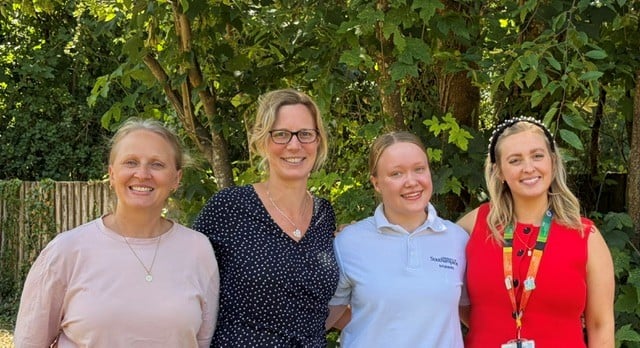
This article explores that question through the exemplary experience of Simoné Conradie, a physiotherapy student who recently completed a six-week placement at the Hampshire and Isle of Wight NHS Healthcare Foundation Trust, supported by Amy Upton (Senior Stroke Physiotherapist), Emily Mace and Jennie Strickland (Learning Environment Team).
This story illustrates:
• The ingredients of well-run placements
• What strong and supportive supervision looks like
• Why this recipe can help students thrive
• How services benefit from a fresh perspective and a willing pair of hands
Overview
As well as clinical care, Simoné took on two service improvement projects during her placement, undertaking a split clinical and leadership placement. The first, with the Learning Environment Team, explored students’ experience of placement induction; the second, with the Stroke Therapy Team, explored patients’ experiences of a stroke rehabilitation exercise class.
Both projects gave the Trust an evidence-based set of recommendations for future improvements to student experience and patient care.
You can read the case studies, including the outcomes, on our student hub:
Placement case study: induction experience project
Placement case study: stroke exercise class evaluation project
The ingredients
1. Groundwork
The factors that made Simoné’s placement so effective began early in her education journey.
At the University of Southampton’s physiotherapy programme, the four pillars of practice are embedded within learning, and students engage with all pillars from the start of their studies.
During practice-based learning, learners are encouraged to explore opportunities beyond direct patient care and aim for at least one of their five placements to take place outside a traditional clinical environment, where leadership, education and research opportunities are often more visible and explicitly developed.
2. Effective planning
Hampshire and the Isle of Wight Healthcare Foundation Trust has a Learning Environment Team (LET), which prepares the ground for effective placement by working with practice educators and education institutions.
They provide:
- A pre-placement induction handbook for students
- Pre-placement resources for practice educators, in line with the Safe Learning Environment Charter
- Pre-placement information that allows teams to prepare for the students they will be supporting
Effective planning also took place for Simoné’s placement itself. Jennie and Emily from the Learning Environment Team planned the placement collaboratively with the Stroke Team, agreeing logistics prior to it starting, and making expectations clear from the outset.
3. A safe and supportive learning environment
One crucial factor, however, was that the practice educators provided a safe and supportive learning environment, in line with NHS England's Safe Learning Environment Charter:
- From the beginning, Simoné was welcomed into the team, given appropriate contacts and encouraged to ask for support when needed
- Both projects were agreed collaboratively, giving her ownership and involvement in shaping her work
- Independent working was encouraged, with support provided around time management
- Simoné had access to regular check ins and supervision throughout, which allowed the team to monitor wellbeing, track project progress, discuss any challenges and problem-solve together
- She completed weekly written reflections, and was encouraged to collect feedback from others
The outcome
Simoné Conradie, physiotherapy student:
‘'I’m really passionate about increasing an individual’s confidence in their ability, and these were very fitting projects for that! Hearing how patients were getting on with their goals and the role healthcare professionals had in that was fantastic.
‘My supervisors were incredibly supportive in encouraging me to be independent, whilst always going above and beyond to help me. I think students gain a lot from their supervisors and this relationship shapes a significant part of their perspective of the speciality and their confidence in a clinical setting.
‘In both projects, it was clear that individualised needs being addressed (whether with a patient or student) was incredibly significant. I believe this is something that has impacted my practice since placement.
‘If I could give any advice to future students on placements, don’t be afraid to get stuck in and take every opportunity that comes up!’ ’
Amy Upton, Senior Stroke Physiotherapist:
‘'Simoné’s proactivity, independent working skills and desire to succeed certainly helped drive the success of these projects.
‘The data collection and analysis of this data is something that took time to complete, so by Simoné supporting with these, it helped with both teams’ workloads. The findings from these projects will be beneficial in improving our services going forwards, which ultimately has the potential to improve service user and student experience in the future.
‘We would encourage all practice educators to think broadly about what a student placement could look like and how students can add value to the service.’ ’
Lindsay O’Connor, Programme Lead Physiotherapy, Senior Teaching Fellow Neurological Physiotherapy, University of Southampton:
‘'Simone's brilliant work on the stroke exercise class and placement induction projects demonstrates the impact of placements that are designed to support development across the four pillars of practice can have. Through these initiatives, she has made a meaningful contribution to both service users and future learners, leaving a legacy that will extend far beyond her placement.’ ’